Dear John,
Greetings from our home laboratory. While you’re sitting at the computer presenting on your simulations, I’m a room-length away, mixing and chopping and scheming. While these concoctions simmer, I’ll be a dutiful scientist and document my four experiments. Maybe it’ll make it easier to plan something in the future.
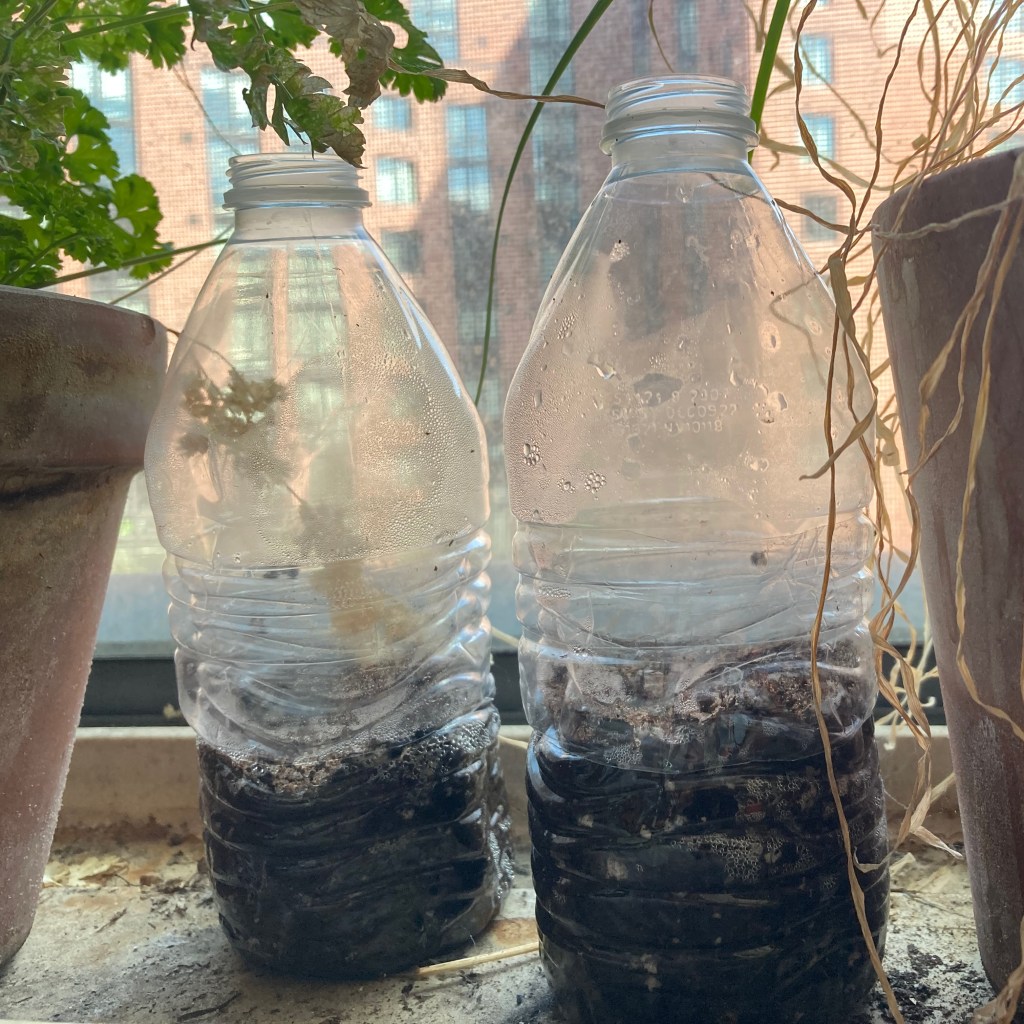


#1 Growing
Our cilantro has all flowered and faded. We’re left with the seedheads. And, while coriander is a pantry staple, I’m more excited about the possibility of more cilantro this fall. The plant does better in cooler weather anyway, right?
I’m attempting the trick we learned from Ros of starting seeds in plastic bottles. I took a couple of water bottles out of the recycling, found a flatter circle going across the diameter and used it as a guide to cut them in half. Bottom half got a handful of potting mix. Four to six seeds poked in with a chopstick. Splash of water. I cut a slit at the top of the base so I could squeeze it together and put the top half of the water bottle back on top. Voila window sill greenhouse.
Next question, will we get sprouts? Tune back in 7-14 days.
#2 Fermenting
We decided to take the CSA jalapenos and try fermenting a hot sauce. Here’s what went in the jar:
- 340 grams jalapenos
- 35 grams red onion
- 140 g wrinkly blueberries (I’ve been putting the mushy berries in the freezer. This seems like the right use for them)
- ~1 gram of coriander seed from the garden (That which did not get planted)
- 3% brine
- Dash of brine from last year’s fermentation
Waiting a week, or two, to see how it tastes.
#3 Cooking
Enough of the volun-beans have dried on the vine that I can cook with them as a dry bean. I took a half cup of beans, covered them with water, added some dried rosemary, salt, and pepper corns. It’s been simmering on the stove for a while now. To be fair, I didn’t give them any soaking time. That’s supposed to be the great equalizer of beans. I figure we know these dried beans are fresh.
They’re not done yet, but the ones I’ve tested seemed nice. Trying again in, let’s say, 7-14 minutes.
#4 Reducing
Recipes for canning tomatoes start with at least a few pounds of tomatoes. Although our harvest is coming in quicker than our consumption, we haven’t amassed that much. But since the collection on the counter is all paste tomatoes and since some of them were starting to pass their peak, I’m trying my hand at making a paste. Mostly following the conserva recipe from Six Seasons. Cut them up, put them in the dutch oven with a put of olive oil. Currently they’ve cooked to sauciness. Next step is to dig out the food mill and use it to separate the seeds and the skins. (And yes, I’m going to try making tomato skin salt.) Then keep up the low and slow cooking. Decision here, maybe 7 hours. Who doesn’t love a theme?
 Planning Inside The Box